
DMEDI stands for Define, Measure, Explore, Develop, Implement, a five-phase Design for Six Sigma (DFSS) methodology used to design a new process, product, or service rather than improve an existing one. It matters because the standard Six Sigma roadmap, DMAIC, assumes a process already exists and simply needs to perform better; DMEDI is built for situations where no adequate process exists yet, so the team needs room to generate and test genuinely new concepts.
In practice, teams define the project scope, measure customer and business requirements, explore multiple candidate design concepts, develop the strongest concept in detail, and implement it through a controlled pilot. The outcome is a new process or product designed around validated customer requirements from the start, rather than retrofitted onto them later.
Quick Reference Table
| Element | What It Means | Why It Matters | Example |
| DMEDI | A DFSS roadmap: Define, Measure, Explore, Develop, Implement | Used to design new processes, products, or services from scratch | Designing a new customer onboarding process that doesn’t yet exist |
| DFSS (Design for Six Sigma) | The umbrella category of methodologies for designing new solutions | DMEDI is one specific roadmap within this category, not a synonym for it | DMEDI, DMADV, and IDOV are all DFSS roadmaps |
| DMAIC | Define, Measure, Analyze, Improve, Control | The methodology for improving an existing process, not designing a new one | Reducing defects in a process that already runs |
| Explore Phase | DMEDI’s phase for generating multiple candidate design concepts | The phase where DMEDI most clearly diverges from DMAIC’s Analyze phase | Brainstorming three different service delivery models before choosing one |
| DMADV | Define, Measure, Analyze, Design, Verify | Another DFSS roadmap, generally more structured and requirements-driven than DMEDI | Designing a new product against a fixed set of technical specifications |
Table of contents
Key Takeaways
- DMEDI is a Design for Six Sigma (DFSS) methodology, not a variant of DMAIC. It belongs to a different category built for designing new solutions, not improving existing ones.
- The Explore phase is what distinguishes DMEDI from every other Six Sigma roadmap. It is dedicated specifically to generating multiple candidate design concepts before selecting one to develop further.
- DMEDI is used when no adequate process, product, or service currently exists, or when the existing one is so far from meeting requirements that incremental improvement (DMAIC) would not close the gap.
- DMEDI and DMADV solve a similar problem with a different emphasis. DMADV tends to be more structured and requirements-driven throughout; DMEDI places more emphasis on open-ended concept generation in the Explore phase.
- A pilot in the Implement phase is standard practice, validating the new design under real conditions before full-scale rollout.
- DMEDI projects typically follow a mature DMAIC deployment. Organizations usually adopt DMEDI after their Six Sigma program has enough experience to take on design-level, not just improvement-level, initiatives.
- Choosing the wrong roadmap wastes effort. Applying DMAIC’s improvement logic to a process that doesn’t exist yet, or applying DMEDI’s design logic to a process that just needs incremental fixes, both produce a poor fit between method and problem.
What Is DMEDI?
DMEDI is a five-phase methodology, Define, Measure, Explore, Develop, Implement, used within Design for Six Sigma (DFSS) to create new processes, products, or services. Where standard Six Sigma (DMAIC) works to reduce defects and variation in something that already exists, DMEDI is used when the thing itself doesn’t yet exist, or exists in a form so inadequate that redesigning it makes more sense than trying to improve it incrementally.
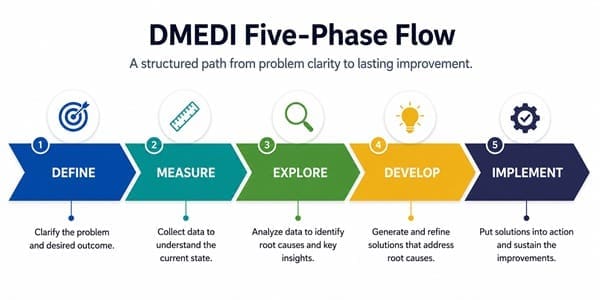
DMEDI falls under the umbrella of Design for Six Sigma (DFSS), providing a structured, data-driven approach to creating new processes or products tailored to meet customer and business requirements from the outset, rather than discovering those requirements after something has already been built and deployed.

Public, Onsite, Virtual, and Online Six Sigma Certification Training!
- We are accredited by the IASSC.
- Live Public Training at 52 Sites.
- Live Virtual Training.
- Onsite Training (at your organization).
- Interactive Online (self-paced) training,
Why Does DMEDI Matter?
The core reason DMEDI exists is that DMAIC’s logic doesn’t work when there’s nothing to measure yet. DMAIC’s Measure and Analyze phases assume a functioning process is already generating data about its own performance. A new process or product has no operating history to analyze.
DMAIC is an analytical, data-driven approach to eliminating weaknesses in active processes, products, and services, focused on reducing variation and defects to produce incremental improvements. DMEDI, by contrast, is a creative approach to designing entirely new, robust processes, products, and services.

This distinction matters practically because using the wrong roadmap wastes project time. A team trying to “analyze” a process that doesn’t exist yet has nothing concrete to analyze; a team trying to “explore” alternative concepts for a process that already works well is solving a problem that doesn’t need solving.
How Do DMEDI’s Five Phases Work?
Define
The Define phase establishes the project charter: business case, scope, expected outcomes, and customer requirements. This looks similar to DMAIC’s Define phase in structure, but the underlying question is different, defining what a new solution needs to accomplish, not what’s wrong with an existing one.
Measure
The Measure phase in DMEDI gathers Critical Customer Requirements (CCRs) and translates them into measurable design targets. Because there is often no existing process to baseline, this phase requires more extensive examination than DMAIC’s Measure phase, since there is little or no existing Critical Customer Requirement data, process definition, or baseline output to draw from.
Explore
This is DMEDI’s defining phase, and the one with no direct DMAIC equivalent. The Explore phase is dedicated to producing a workable design concept for a new process, typically by generating multiple candidate approaches and evaluating them against the requirements defined earlier. Teams often use structured brainstorming methods, sometimes run as a focused Kaizen-style event, to generate genuinely different concepts rather than converging too early on a single idea.
Develop
The Develop phase delivers an optimal design based primarily on meeting customer requirements, taking the strongest concept from Explore and detailing it: specific process steps, resource requirements, technology, and controls needed to make the design work in practice.
Implement
The Implement phase includes a pilot, a permanent, full-scale deployment that establishes control charts and control plans to monitor the new process going forward. This mirrors DMAIC’s Control phase in function, ensuring the new design performs as intended once it’s live, rather than only in concept.
DMEDI vs. DMAIC: How Do They Compare?
| Factor | DMEDI | DMAIC |
| Applies to | New processes, products, or services that don’t yet exist | Existing processes that need incremental improvement |
| Core question | “What should this new solution look like?” | “What’s wrong with this existing process?” |
| Distinguishing phase | Explore (concept generation) | Analyze (root cause investigation) |
| Data availability at start | Little to none; requirements must be gathered from scratch | Existing process data available as a baseline |
| Typical outcome | A newly designed process, product, or service | An improved version of a process already in operation |
How do you decide which one your project needs? If the process, product, or service already exists and is underperforming, DMAIC is the correct roadmap. If it doesn’t exist yet, or the gap between current and required performance is so large that a redesign makes more sense than incremental fixes, DMEDI is the better fit.
Also Read: How Xerox Built a Company-Wide Lean Six Sigma Program
DMEDI vs. DMADV: What’s the Real Difference?
Both DMEDI and DMADV are DFSS roadmaps used to design new solutions, and the overlap between them is real; this is the comparison most competing content explains vaguely or skips entirely.
| Factor | DMEDI | DMADV |
| Full name | Define, Measure, Explore, Develop, Implement | Define, Measure, Analyze, Design, Verify |
| Concept generation approach | Dedicated Explore phase for generating multiple design alternatives | Analyze phase focuses more on analyzing requirements and constraints than generating alternative concepts |
| Best fit | Projects where the solution isn’t well-defined yet and benefits from open concept generation | Projects with clearer technical specifications where the design path is more structured from the start |
| Final validation phase | Implement (includes a pilot and control plan) | Verify (confirms the design meets requirements before full rollout) |
How does this affect the practical choice?
DMEDI’s Explore phase gives teams more room to generate and compare genuinely different approaches before committing to one. DMADV tends to suit projects where the requirements are already well-defined and the main task is executing a rigorous design and verification process against them, rather than generating multiple concepts from an open starting point.
When Should You Use DMEDI?
Use DMEDI when:
- No adequate process, product, or service currently exists to meet the requirement.
- The gap between current performance and required performance is large enough that incremental improvement (DMAIC) would not close it.
- The project benefits from generating and comparing multiple design concepts before committing to one.
- Your organization’s Six Sigma program has matured enough to take on design-level, not just improvement-level, initiatives.
Use DMAIC instead when:
- A process already exists and is generating usable performance data.
- The problem is a defect, delay, or variation issue in something already operating, not a design gap.
Real-World Example (Hypothetical)
Problem: A regional bank wants to launch a new small-business loan approval process. No comparable process currently exists internally; loan officers have historically handled small-business requests informally, with no standardized workflow.
Analysis: Because there is no existing process to measure or analyze, a DMAIC approach has nothing concrete to baseline. The team recognizes this as a design problem, not an improvement problem.
Six Sigma approach: The project follows DMEDI. Define establishes the charter and scope; Measure gathers Critical Customer Requirements from both small-business applicants and internal underwriting staff; Explore generates three candidate workflow concepts (fully digital, hybrid, and advisor-led); Develop details the strongest concept, a hybrid digital-plus-advisor model, into a full process design.
Action: Implement runs a pilot of the new process with a limited set of branches before full rollout, with control plans established to monitor approval time and error rate.
Result (hypothetical): The bank launches with a process built around validated customer requirements from the outset, rather than retrofitting fixes onto an informal process after the fact. This is a hypothetical illustration of the DMEDI pattern, not a documented case study.
Also Read: How Caterpillar Used Six Sigma to Hit $30 Billion in Revenue Two Years Early
Common Mistakes When Applying DMEDI
- Using DMEDI on a project that should be DMAIC. If a working process already exists, DMEDI’s concept-generation approach adds unnecessary time and complexity.
- Rushing or skipping the Explore phase. Converging on a single design concept too early defeats the purpose of using DMEDI over a more structured DFSS roadmap like DMADV.
- Treating Measure as a formality. Without an existing process to baseline, skipping thorough Critical Customer Requirement gathering leaves the entire design built on assumptions rather than validated needs.
- Skipping the pilot in Implement. Moving straight to full-scale deployment without piloting removes the opportunity to catch design flaws before they affect the full customer or user base.
- Confusing DMEDI with DMADV and using the terms interchangeably. The two roadmaps share a category but differ in structure and are suited to different types of design projects.
Frequently Asked Questions (FAQs) on DMEDI
Q: What does DMEDI stand for?
A: Define, Measure, Explore, Develop, Implement. It is a five-phase Design for Six Sigma (DFSS) methodology used to design new processes, products, or services.
Q: Is DMEDI part of DMAIC or a separate methodology?
A: DMEDI is a separate methodology from DMAIC. Both fall under the broader Six Sigma umbrella, but DMAIC improves existing processes while DMEDI is used to design new ones under the Design for Six Sigma (DFSS) category.
Q: What is the difference between DMEDI and DMADV?
A: Both are DFSS roadmaps for designing new solutions. DMEDI includes a dedicated Explore phase for generating multiple design concepts, making it better suited to open-ended design problems, while DMADV tends to be more structured and requirements-driven throughout, suiting projects with clearer technical specifications from the start.
Q: When should you use DMEDI instead of DMAIC?
A: Use DMEDI when no adequate process, product, or service currently exists, or when the performance gap is too large for incremental improvement to close. Use DMAIC when an existing process needs to perform better, not be redesigned from scratch.
Q: What happens in the Explore phase of DMEDI?
A: The team generates multiple candidate design concepts and evaluates them against the customer and business requirements established in the Measure phase, often through structured brainstorming or a focused workshop, before selecting the strongest concept to detail further in Develop.
Q: Who typically leads a DMEDI project?
A: DMEDI projects are typically led by Black Belts or Master Black Belts with DFSS training, often supported by quality managers, process engineers, or business analysts contributing subject-matter and customer-requirement expertise.
Final Words
DMEDI exists for a specific situation DMAIC was never built to handle: designing something that doesn’t exist yet. The Explore phase is what makes it distinct, giving teams room to generate and compare real alternatives instead of converging too early on the first workable idea. Choosing DMEDI, DMADV, or DMAIC correctly, based on whether you’re designing something new or improving something that already exists, is what keeps a Six Sigma project’s methodology matched to the actual problem in front of it.
Knowing when to reach for DMEDI instead of DMAIC or DMADV is a design-for-Six-Sigma-level skill most Green Belt programs don’t fully cover.
Six Sigma Development Solutions, Inc. (SSDSI) is IASSC-accredited and 5-star rated on Google Reviews, having certified 5,322+ professionals across 600+ organizations in 52 cities. Our onsite, live virtual, public, and online Black Belt training builds the judgment to select and apply the right roadmap, DMAIC, DMEDI, or DMADV, for the problem actually in front of your team. Explore SSDSI’s Black Belt certification to build that capability.
View our upcoming live virtual Green Belt or Black Belt training schedule and train with a curriculum built on a verified accreditation standard.
About Six Sigma Development Solutions, Inc.
Six Sigma Development Solutions, Inc. offers onsite, public, and virtual Lean Six Sigma certification training. We are an Accredited Training Organization by the IASSC (International Association of Six Sigma Certification). We offer Lean Six Sigma Green Belt, Black Belt, and Yellow Belt, as well as LEAN certifications.
Book a Call and Let us know how we can help meet your training needs.


