Have you ever worked on a project where a small, unexpected change caused huge problems later on? It can feel like everything is going well until one simple request throws the entire schedule and budget off track. You need a reliable way to review, approve, and manage these changes so your project stays on course.
This is where the Change Control Board (CCB) plays a vital role. The CCB is a formalized group that ensures only necessary, well-planned, and beneficial changes affect your project. Understanding how this board operates and who is involved allows you to avoid costly delays and scope creep.
Let us now understand what the Change Control Board is and how it helps maintain project integrity.
Table of contents
What is Change Control Board?
The Change Control Board (CCB) can be understood as a formal group of stakeholders. This group has the responsibility of reviewing, evaluating, approving, or rejecting proposed changes to a project’s baseline documents or deliverables. A Change Control Board acts as a governing body within the crucial change management process.
The CCB essentially serves as the gatekeeper for all proposed changes. It ensures that every single modification undergoes a structured evaluation. This evaluation makes certain that the proposed change provides more value than the risk or effort it requires to implement.
CCB implies that a structured method exists for managing changes, preventing random modifications from negatively influencing the project’s scope, budget, or timeline.

Public, Onsite, Virtual, and Online Six Sigma Certification Training!
- We are accredited by the IASSC.
- Live Public Training at 52 Sites.
- Live Virtual Training.
- Onsite Training (at your organization).
- Interactive Online (self-paced) training,
Why Does the Change Control Board Matter to Your Project?
CCB plays a vital role because projects operate on a defined baseline. This baseline comprises the approved scope, schedule, and cost. When someone proposes a change, it affects this established baseline.
Due to the pooling of expertise from various members, the Change Control Board ensures that the decision to implement a change is objective, considering all aspects like technical feasibility, financial impact, and business value. This prevents uncontrolled scope growth, commonly known as scope creep.
Also Read: How to Integrate Control Charts with Six Sigma Tools
Change Management Process
The Change Control Board is the central component of a larger change management process. This systematic procedure is what an organization uses to handle all requests for changes.
The change management process typically includes the following sequential steps:
- Change Request Initiation: The process starts when a project stakeholder submits a change request. This request documents the proposed change, the reason for it, and the anticipated benefits.
- Change Request Logging: The project manager or a designated coordinator logs the change request and ensures it is complete. This action provides a record for tracking purposes.
- Initial Assessment and Analysis: A team or the project manager performs an initial analysis. This analysis determines the potential impact on the project schedule, cost baseline, and resources.
- CCB Review and Decision: The Change Control Board reviews the analyzed request. The CCB then decides whether to approve, reject, or defer the change.
- Change Implementation: If the CCB approves the change, the project team implements the change as per the approved plan.
- Change Verification: The implemented change then undergoes verification to confirm it meets the requirements and does not cause new problems.
- Closure: The project manager updates the project documentation and formally closes the change request.
The Change Control Board focuses on step 4, where the critical decision takes place.
Who Comprises the Change Control Board?
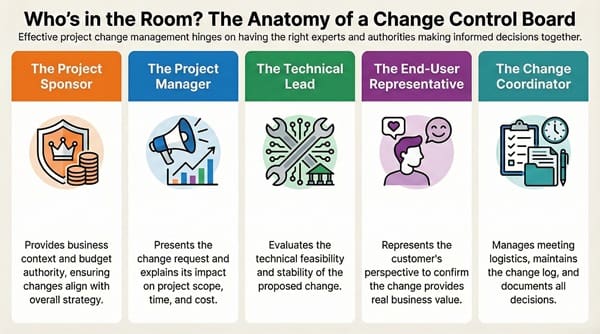
The composition of the Change Control Board is crucial for its effectiveness. The members provide the necessary expertise and authority to make informed decisions.
A typical CCB comprises the following key members:
- Project Sponsor (or an Executive): This person provides the business context and the budget authority. They ensure the change aligns with the overall business strategy.
- Project Manager: The project manager presents the change request and explains the impact on the project’s triple constraints (scope, time, cost). They manage the implementation of the approved change.
- Technical Lead or Subject Matter Expert (SME): This member evaluates the technical feasibility of the change. They ensure the modification is possible and does not introduce technical debt or system instability.
- Key Stakeholder(s) or End-User Representative: This person represents the customer’s or user’s perspective. They determine if the change provides actual business value or resolves a critical user need.
- Change Control Coordinator (Secretary): This individual maintains the change request log, schedules CCB meetings, and documents all decisions.
The size and specific roles within the Change Control Board are variable. They depend directly on the size and complexity of the project or organization.
Also Read: Out of Control Plan (OCAP)
Change Control Board’s Key Responsibilities
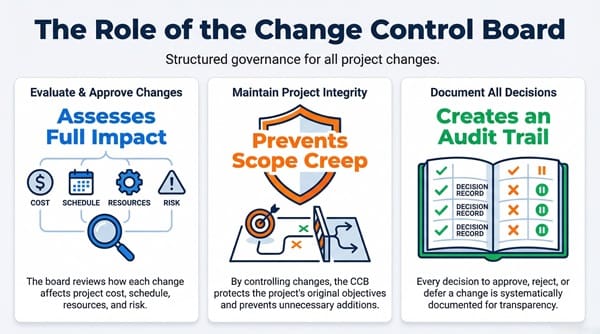
The primary functions of the Change Control Board focus on governance and oversight. The CCB performs, executes, and accomplishes several vital tasks.
Evaluating and Approving Change Requests
This is the most essential function. The CCB reviews each submitted change request thoroughly.
- Assessment of Impact: The board determines the complete impact of the change on the project baseline. This includes assessing the effect on cost, schedule, resources, quality, and risk.
- Prioritization: The board assigns a priority level to the approved change requests (e.g., High, Medium, Low). This guides the project team on which changes to work on first.
- Decision Making: The CCB decides whether to approve, reject, defer, or request more information on the change.
Maintaining Project Integrity
The Change Control Board ensures that the project remains aligned with its original objectives.
- Scope Protection: The CCB prevents unnecessary scope creep. By strictly controlling which changes enter the project, the board prevents random additions that have little value.
- Resource Management: The board ensures the availability of necessary resources (personnel, budget, time) before approving a change that requires them.
Documenting Decisions
The CCB ensures that all activities and decisions are documented systematically.
- Audit Trail: The board creates a complete audit trail for every single change request. This documentation explains who requested the change, why, the estimated impact, and the final decision.
- Communication: The CCB ensures clear communication of all decisions to the project team and relevant stakeholders.
Change Control Board vs. Project Steering Committee
People often confuse the Change Control Board with the Project Steering Committee. While both groups focus on project governance, their scope and focus are very different.
Let us now discuss the key differences between a Change Control Board and a Project Steering Committee.
| Basis for Comparison | Change Control Board (CCB) | Project Steering Committee |
| Primary Focus | Managing individual changes to the project baseline (scope, schedule, cost). | Providing strategic direction and overall oversight for the entire project. |
| Level of Detail | Highly detailed; evaluates the technical and tactical impact of specific changes. | High-level and strategic; focuses on project health, risks, and alignment with business goals. |
| Meeting Frequency | Meets as needed when change requests accumulate, sometimes weekly or bi-weekly. | Meets periodically (e.g., monthly) for status updates and strategic review. |
| Key Decisions | Approve, reject, or defer specific change requests. | Approve major phase exits, resolve high-level risks, and secure project funding. |
| Scope of Authority | Focuses on the project deliverables and documentation. | Focuses on the business objective and organizational alignment. |
A Project Steering Committee might ask the CCB to review a category of changes. Conversely, the CCB might escalate a significant, project-altering change to the Steering Committee for final strategic approval.
Also Read: Quality Control Tools
Implementing an Effective Change Control Board
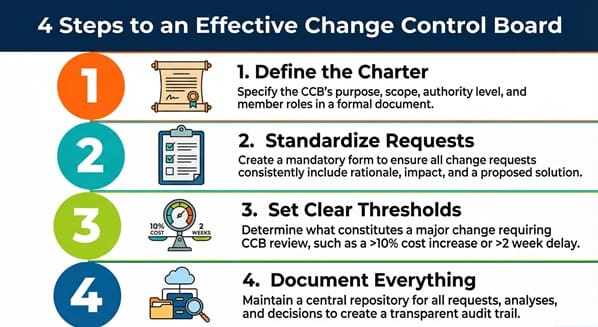
Implementing a Change Control Board is essential so as to facilitate smooth project execution. Here are the steps involved in establishing an effective CCB.
1. Define the CCB Charter
The first action is to define the CCB Charter. This document specifies:
- The purpose and scope of the CCB.
- The specific types of changes that must go through the board.
- The authority level of the CCB (i.e., which changes it can approve without further escalation).
- The composition and roles of the members.
2. Establish a Standard Change Request Form
The second action is to create a mandatory Change Request Form. This form requires the requester to provide all necessary information so as to allow for a proper evaluation.
- Change Request forms must clearly indicate the rationale, impact on the project schedule and budget, and the proposed solution.
- The use of a standard form ensures that the CCB receives all relevant data in a consistent format.
3. Set Clear Thresholds for Change
The third action is to establish clear thresholds. Not every minor adjustment needs CCB review.
- The organization determines what constitutes a minor change (handled by the project manager) and a major change (requiring CCB review).
- For example, a major change is one that increases the cost baseline by more than 10% or delays the critical path by more than two weeks.
4. Systematically Document Everything
The fourth action is to implement a robust system for tracking and documenting changes.
- This system maintains the audit trail required for transparency and compliance.
- The change requests, impact analysis, CCB meeting minutes, and the final decision must all be saved in a central repository.
Change Control Board and Scope Creep Prevention
Scope creep is nothing but the gradual expansion of project requirements beyond the initial scope baseline. This occurs without corresponding adjustments to time, cost, or resources. The Change Control Board acts as the primary defense mechanism against this threat.
- CCB ensures that every change is intentional. It prevents changes from slipping in informally through verbal agreements or undocumented requests.
- The board requires a compelling business case for every change. If the change does not significantly contribute to the project’s goal, the CCB rejects it.
- If the CCB approves a change, it simultaneously mandates the necessary adjustments to the cost baseline and project schedule. This ensures that the change is properly funded and planned for.
What are the risks if we do not use a Change Control Board? Without a CCB, a project tends to spiral out of control. This leads to budget overruns, missed deadlines, and a final product that does not meet the original, intended goal.
Frequently Asked Questions about the Change Control Board
Q1. When does the Change Control Board meet?
The Change Control Board usually meets periodically (e.g., weekly) if a project generates a constant flow of change requests. Alternatively, the CCB meets on an ad-hoc basis whenever a sufficient number of change requests accumulate. The frequency depends on the needs of the project integrity.
Q2. Does every project require a Change Control Board?
While every project needs a change management process, a formal Change Control Board is generally required for large, complex projects. This includes projects with significant budget, high regulatory compliance, or projects that involve multiple departments and external vendors. Small projects can often manage changes through the Project Manager and Project Sponsor.
Q3. What happens if the CCB rejects a change request?
If the Change Control Board rejects a request, the coordinator documents the reason for the rejection. The requester is then informed of the decision. The requester can sometimes resubmit the change request with new, more comprehensive information and justification.
Q4. What is the difference between a Change Control Board and a Configuration Management System?
The Change Control Board makes the decision about which changes to implement. The Configuration Management System is the set of tools and procedures that tracks, records, and controls the physical changes to the project’s products, baselines, and documentation. The CCB uses the data from the Configuration Management System to make its decisions.
Key Takeaways
- The Change Control Board (CCB) is a formal decision-making group. It reviews, evaluates, and controls all proposed changes to a project’s baseline.
- The CCB is the central component of the overall change management process.
- CCB composition typically includes the Project Sponsor, Project Manager, and Technical Leads. This diverse membership ensures comprehensive impact analysis.
- The board’s main role is to protect the project’s integrity and prevent scope creep.
- The CCB and the Project Steering Committee have different focuses: the CCB manages tactical changes, while the Committee provides strategic oversight.
- Establishing a CCB Charter and a standard Change Request Form facilitates an efficient process.
Final Words
Maintaining a project’s focus and budget requires discipline. Establishing a robust Change Control Board is the definitive step toward achieving this discipline. The right structure helps you ensure that every modification contributes positively to the final result.
Are you ready to implement a CCB that provides your projects with the governance they need? Our specialized services help your organization design and deploy change control processes that work for your unique environment.
Contact us today to begin building a process that guarantees project integrity and delivers successful outcomes every time.