
Making complex decisions often feels like a puzzle with too many pieces. You might have several good options, but each one has different strengths. How do you choose the best one without just guessing? This is where the Analytic Hierarchy Process (AHP) comes into play.
Analytic hierarchy process is a structured technique for organizing and analyzing complex decisions. Developed by Thomas Saaty in the 1970s, it helps people set priorities and make the best choice when both qualitative and quantitative aspects need consideration. Instead of picking one “right” answer immediately, you break the problem down into smaller, manageable parts.
Have you ever wondered why some decisions feel so heavy? It is usually because we try to weigh everything at once. Analytic hierarchy process changes this by using a mathematical framework to handle human psychology. It allows you to compare things in pairs, making the logic much easier to follow.
Table of contents
Comparison of Analytic Hierarchy Process vs. Traditional Decision Making
To understand why this method is unique, let us look at how it differs from standard “gut-feeling” or simple list-making approaches.
| Basis for Comparison | Traditional Decision Making | Analytic Hierarchy Process (AHP) |
| Structure | Often informal or unstructured. | Highly structured and hierarchical. |
| Criteria Handling | Focuses mostly on data or just intuition. | Balances hard data with human judgment. |
| Comparison Method | Views all options simultaneously. | Uses pairwise comparisons for accuracy. |
| Consistency Check | No way to measure logic errors. | Includes a Consistency Ratio (CR). |
| Complexity | Struggles with many variables. | Handles multi-level criteria effectively. |
Define Analytic Hierarchy Process and Its Core Logic
When we define analytic hierarchy process, we describe it as a multi-criteria decision-making tool. It represents the way the human brain naturally processes information. We tend to group items with similar features and then compare them.
The analytic hierarchy process model works because it recognizes that humans are better at comparing two things at once than a dozen things at once. If I ask you to rank ten cars, you might struggle. If I ask you to choose between two based only on fuel efficiency, the choice is clear. AHP collects these small, clear choices and builds a big picture.
It is vital to note that AHP does not just rely on numbers. It allows experts to use their experience to “weight” certain factors. This makes the AHP a favorite in fields like engineering, healthcare, and government planning.

Public, Onsite, Virtual, and Online Six Sigma Certification Training!
- We are accredited by the IASSC.
- Live Public Training at 52 Sites.
- Live Virtual Training.
- Onsite Training (at your organization).
- Interactive Online (self-paced) training,
The Analytic Hierarchy Process Model Structure
To use the analytic hierarchy process model effectively, you must visualize your problem as a pyramid. This structure ensures that every detail connects back to your main goal.
The Goal
This sits at the very top. It is the single objective you want to achieve. For example, “Selecting the best supplier” or “Choosing a new office location.”
The Criteria
These are the factors that matter to you. If you are buying a car, criteria might include price, safety, and style. You can also have sub-criteria. Under “safety,” you might have “crash test ratings” and “number of airbags.”
The Alternatives
These are the actual choices you have. These sit at the bottom of the hierarchy. Every alternative is eventually measured against every criterion to see how well it fits.
Analytical Hierarchy Process Steps
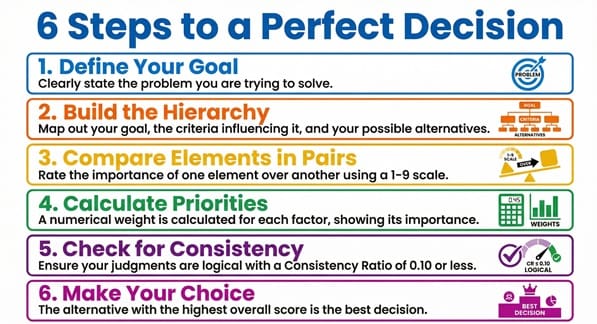
If you want to know how to do analytical hierarchy process, you must follow a specific sequence. This ensures the math remains valid and the results are reliable.
1. Define the Problem and Goal
You must start with a clear mind. What exactly are you trying to solve? Write this down as your primary goal. Without a specific goal, the rest of the analytical hierarchy process steps will lack direction.
2. Build the Hierarchy
Analytic hierarchy process requires you to list every factor that influences your goal. Arrange these from the top (goal) through the middle (criteria) to the bottom (alternatives).
3. Collect Data Through Pairwise Comparisons
This is the heart of the method. You compare two elements at a time. For each pair, you ask: “Which is more important regarding the goal?” You use a scale from 1 to 9.
- 1 means both are equally important.
- 9 means one is extremely more important than the other.
4. Calculate Weights and Priorities
Once you have the comparisons, you put them into a matrix. Through mathematical calculations (often involving Eigenvectors), the analytic hierarchy process model assigns a numerical weight to each factor. These weights must add up to 1.0 (or 100%).
5. Check for Consistency
Humans are not always logical. If you say A is better than B, and B is better than C, but then say C is better than A, you are inconsistent. The analytic hierarchy process calculates a Consistency Ratio. If this ratio is 0.10 or less, your judgments are reliable.
6. Final Synthesis
Finally, you combine all the weights to see which alternative has the highest score. The option with the highest global weight is your best choice.
Analytical Hierarchy Process A Step by Step Approach in Practice
Let us look at analytical hierarchy process a step by step approach using a real-world scenario: Selecting a software vendor.
AHP begins by setting “Quality,” “Price,” and “Support” as criteria. You then compare Quality vs. Price. If you are a high-end firm, you might give Quality a 7 on the scale compared to Price.
Next, you compare the vendors (alternatives) against those criteria. Vendor A might have great support but a high price. Vendor B might be cheap but has poor quality. By the time you finish the analytical hierarchy process steps, the math tells you exactly which vendor offers the best balance for your specific needs.
Why do we do this? It removes the “loudest voice in the room” problem. In many companies, the boss picks what they like. With the analytic hierarchy process, the data and logic drive the decision.
How to Do Analytical Hierarchy Process Successfully
When you learn how to do analytical hierarchy process, you must pay attention to the scale. Most beginners make the mistake of being too “middle of the road.”
It works best when you are decisive. If a factor is truly more important, give it a high score. Also, involve the right people. If you are making a technical decision, make sure the engineers are the ones doing the pairwise comparisons for the technical criteria.
Another tip for how to do analytical hierarchy process is to keep the hierarchy simple. If you have more than 7 criteria in one level, the number of comparisons becomes overwhelming. Use sub-criteria to group them instead.
Advantages of Using the Analytic Hierarchy Process Model
The analytic hierarchy process model offers several benefits that other methods lack.
- Flexibility: It handles both tangible data (like dollars) and intangible feelings (like brand reputation).
- Transparency: Anyone can look at the matrix and see exactly why a decision was made.
- Consistency: It catches you when your logic fails.
- Consensus Building: It is great for groups. You can average the scores of different stakeholders to find a middle ground.
It acts as a bridge between math and human emotion. It recognizes that we aren’t robots, but it gives us a robotic level of precision when we need it most.
Common Applications of Analytic Hierarchy Process
Where do we see the AHP in action? It is used more often than you might think.
- Manufacturing: Companies use analytical hierarchy process steps to choose between different types of machinery or factory locations.
- Government: Planners use it to decide where to build new bridges or schools based on cost, environmental impact, and public need.
- Education: Universities use the analytic hierarchy process model to rank applicants or allocate research budgets.
- Personal Life: You can even use it to decide which house to buy or which career path to follow.
Frequently Asked Questions on Analytic Hierarchy Process
What is the 1 to 9 scale in AHP?
The scale is used for pairwise comparisons. 1 means equal importance, 3 is moderate, 5 is strong, 7 is very strong, and 9 is extreme importance. Even numbers (2, 4, 6, 8) are used for compromise values.
Can AHP handle negative numbers?
No. The analytic hierarchy process uses positive ratios. Since it measures relative importance, negative values would break the mathematical model used to calculate weights.
How many people should be involved in the process?
There is no set limit. However, the analytic hierarchy process is very effective for small groups of 3 to 10 experts. You can use the “Geometric Mean” to combine their individual judgments into one final matrix.
What happens if my Consistency Ratio is too high?
If your CR is above 0.10, the analytical hierarchy process steps suggest you should re-evaluate your comparisons. You were likely being inconsistent in your logic, and the results might not be trustworthy.
Key Takeaways
- AHP is a structured way to make complex decisions by breaking them into a hierarchy.
- The analytic hierarchy process model uses three levels: Goal, Criteria, and Alternatives.
- Its steps involve pairwise comparisons using a 1-9 scale to determine the importance of factors.
- The system includes a Consistency Ratio to ensure your logic is sound and reliable.
- Learning how to do AHP helps remove bias and creates a clear, transparent path to the best choice.
Final Words
The analytic hierarchy process is more than just a math formula. It is a way to bring order to the chaos of decision-making. By following a step by step approach, you can turn confusing options into a clear, prioritized list.
Whether you are a manager at a large firm or just someone trying to make a big life change, the AHP model provides the clarity you need. We believe in providing tools that empower you to lead with confidence and logic. Our focus is always on your success and helping you navigate complex choices with ease.