What is Affinity Grouping and Why Does Your Team Need It?
Affinity grouping refers to a process where people with shared interests or goals come together to organize ideas or support one another. Have you ever sat in a meeting where everyone shouted ideas at once, but nothing got done? We’ve all been there. It’s messy, and important thoughts often get lost in the noise. That is where the power of an affinity group (AG) comes into play.
In my experience, the best ideas don’t always come from the loudest person in the room. They come from spaces where people feel safe to share. Whether you are sorting sticky notes on a wall or building a support network for employees, this method brings order to chaos. It’s roughly about finding common ground.
But how does it actually work? To be honest, it is simpler than you might think. It is about categorizing information or people based on natural relationships. Think of it as a filing system for human connection and creativity. In this guide, we will explore why this matters for your personal and professional growth.
Table of contents
Understanding the Core of Affinity Grouping
The term affinity grouping can be understood as a way to gather like-minded individuals or similar pieces of data. In a business setting, it often acts as a tool for brainstorming. Imagine your team has fifty different problems to solve. Instead of tackling them one by one, you group them into themes. This helps you see the “big picture” without feeling overwhelmed.
Here is the thing: humans are hardwired to look for patterns. We like to categorize things. When we use an AG in a workplace, we are just using that natural instinct to work smarter. It helps us move from a list of random thoughts to a clear plan of action.

Public, Onsite, Virtual, and Online Six Sigma Certification Training!
- We are accredited by the IASSC.
- Live Public Training at 52 Sites.
- Live Virtual Training.
- Onsite Training (at your organization).
- Interactive Online (self-paced) training,
The Two Sides of Affinity Groups
One must note that this concept serves two main purposes. First, it is a technical tool for data. Second, it is a social tool for people.
- Data Organization: This is often called the “K-J Method.” It involves taking a large list of ideas and sorting them into groups.
- Social Connection: These are groups formed around shared identities, such as race, gender, or hobbies. They provide a “brave space” for members to talk freely.
Why does this distinction matter? Because whether you are organizing notes or people, the goal is the same: to create a sense of belonging and clarity.
Also Read: Matrix Chart
How Does Affinity Grouping Improve Decision Making?
Affinity grouping allows teams to reach a consensus without the usual office politics. In many meetings, a few voices dominate. This leads to “groupthink,” where people just agree to avoid conflict. AGs break this cycle.
In my view, the most successful companies use these groups to ensure every voice is heard. When you group ideas silently on a board, the best ideas rise to the top regardless of who wrote them. It levels the playing field. This is because the focus shifts from who said it to what was said.
The Power of Consensus
Unlike traditional voting, where there are winners and losers, affinity grouping focuses on agreement. We’ve all seen how a “majority wins” approach can leave half the room feeling bitter. AGs aim for a solution that everyone can live with. It might take a bit longer, but the results are usually much more stable.
Steps to Run an Effective Affinity Grouping Session
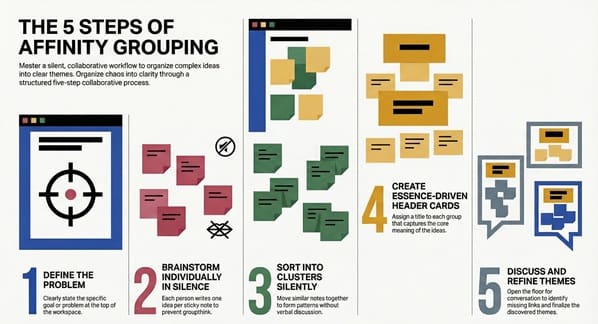
If you want to try this with your team, you don’t need fancy software. You just need a wall, some sticky notes, and an open mind. Here is how we can see the process unfolding:
1. Define the Problem
First, you must state the goal clearly. What are you trying to solve? Write this at the top of the board.
2. Individual Brainstorming
Give everyone a stack of notes. Ask them to write one idea per note. Do this in silence. Why silence? Because it prevents people from influencing each other.
3. Sort Into Clusters
Put all the notes on the wall. As a group, start moving similar ideas together. Don’t talk yet. Just look for patterns. If a note fits in two places, make a copy.
4. Create Header Cards
Once the groups are formed, give each one a title. This title should capture the essence of the ideas below it.
5. Discuss and Refine
Now, you can talk. Do these groups make sense? Is there anything missing? This is where the magic happens. You’ll start to see themes you never noticed before.
The Social Impact of Affinity Groups in the Workplace
While sorting data is great, affinity grouping is also vital for workplace culture. Many organizations call these Employee Resource Groups (ERGs). These are spaces where people with shared lived experiences can connect.
Picture this: You are the only person of your background in a large department. It can feel lonely, right? An AG provides a community where you don’t have to explain yourself. You can just be. This leads to higher retention and happier employees.
Building Safe Spaces
It is important to note that these groups aren’t about excluding others. They are about providing support. When people feel supported, they bring their best selves to work. In my experience, a diverse company with strong affinity groups is always more innovative than one without them.
“Affinity groups provide a sanctuary from the stresses of being a minority in a majority environment.” — Common DEI Perspective
Also Read: How to Write a Six Sigma Business Case
Key Benefits of Using Affinity Grouping
Why should you care about this? Because it saves time and reduces stress. Here are a few reasons why affinity grouping is a game-changer:
- Clearer Communication: It cuts through the fluff and gets to the point.
- Reduced Bias: It focuses on the merit of ideas, not the status of the person.
- Faster Solutions: You can tackle several related problems at once.
- Better Morale: People feel valued when their ideas are literally “on the board.”
Potential Challenges and How to Overcome Them
No system is perfect. Sometimes, affinity grouping can hit a snag. One common issue is having too many notes. If you have 200 notes, the wall becomes a mess. In this case, we should try “pre-sorting” or set a limit on notes per person.
Another challenge is “the loud voice” during the discussion phase. Even if the sorting was silent, some people might try to take over the naming of the groups. As a leader, you must ensure that the consensus remains the priority.
Frequently Asked Questions About Affinity Grouping (FAQs)
What is the difference between a task force and an affinity group?
A task force is usually temporary and focused on one specific job. An AG is often ongoing and focused on a shared identity or a broad way of thinking.
Can small businesses use affinity grouping?
Absolutely. In fact, it’s often easier in small teams. It helps ensure that the “founder’s voice” doesn’t drown out new, fresh ideas.
How many people should be in an affinity group?
For data sorting, 5 to 10 is the sweet spot. For social groups, they can be as small as 3 or as large as 100, though smaller sub-sets usually work better for deep conversation.
Is affinity grouping the same as brainstorming?
Not exactly. Brainstorming is the “getting ideas out” part. Affinity grouping is the “making sense of those ideas” part. You usually do both together.
Key Takeaways on Affinity Grouping
- Affinity grouping simplifies complex problems by finding patterns.
- It encourages equal participation by using silent sorting techniques.
- Social AGs improve employee retention by fostering a sense of belonging.
- The process moves teams from “me vs. you” to “us vs. the problem.”
- Consensus-based decisions are more likely to be supported by the whole team.
Final Words
At the end of the day, affinity grouping is about making life easier for you and your colleagues. It removes the guesswork from collaboration. Whether you are fixing a broken process or trying to build a more inclusive culture, the steps are the same: listen, group, and act.
We believe that every person has something valuable to contribute. Our goal is to help you find the tools to unlock that potential. If you want to build a team that actually enjoys working together, start by finding your common ground.